
Anthropic's Earth's Most Powerful AI So Strong It Made Wall Street Hold Emergency Meeting, But JPMorgan Was Missing Its "Antidote"


On April 8, U.S. Treasury Secretary Benson and Federal Reserve Chair Powell urgently convened CEOs of six systemically important banks at the Treasury Department headquarters in Washington, D.C. to discuss the potential cybersecurity risks posed by Anthropic's new Mythos model. According to Bloomberg, CEOs from Citigroup (Fraser), Morgan Stanley (Gorman), Bank of America (Moynihan), Wells Fargo (Scharf), and Goldman Sachs (Solomon) all attended. JPMorgan Chase (Dimon) was unable to attend due to a "scheduling conflict."
This was not a typical financial regulatory meeting. The last time a Treasury Secretary and Fed Chair jointly summoned bank CEOs to the same room was on October 13, 2008. Paulson and Bernanke had announced a $250 billion TARP funding plan in an attempt to stem an unfolding financial system collapse. This time, the triggering factor was not the market but an AI model.
And this meeting was just the third wave of federal-level regulatory actions against Anthropic within 44 days.
People in the Lab and People in the Room, Virtually No Overlap
Mythos is not scattered uncontrollably around the world. On April 7, Anthropic officially released the Mythos Preview and announced a defensive cybersecurity initiative called Project Glasswing, restricting model access to 12 partner organizations. These 12 include Amazon, Apple, Microsoft, Google, Nvidia, CrowdStrike, Palo Alto Networks, and one financial institution, JPMorgan Chase.
The problem is, the people called to discuss risks and the people who received the defensive tool are almost two different groups.
The five bank CEOs present collectively oversee around $9 trillion in assets. None of their institutions are on the Glasswing list or have access to Mythos. They were called in, reportedly by Bloomberg, to "ensure that banks understand future risks posed by Mythos and similar models and are taking defensive measures." However, the core defensive tool, Mythos itself, is not available to them.
And the only entity that appears on both lists, JPMorgan Chase, had its CEO Dimon conveniently absent.
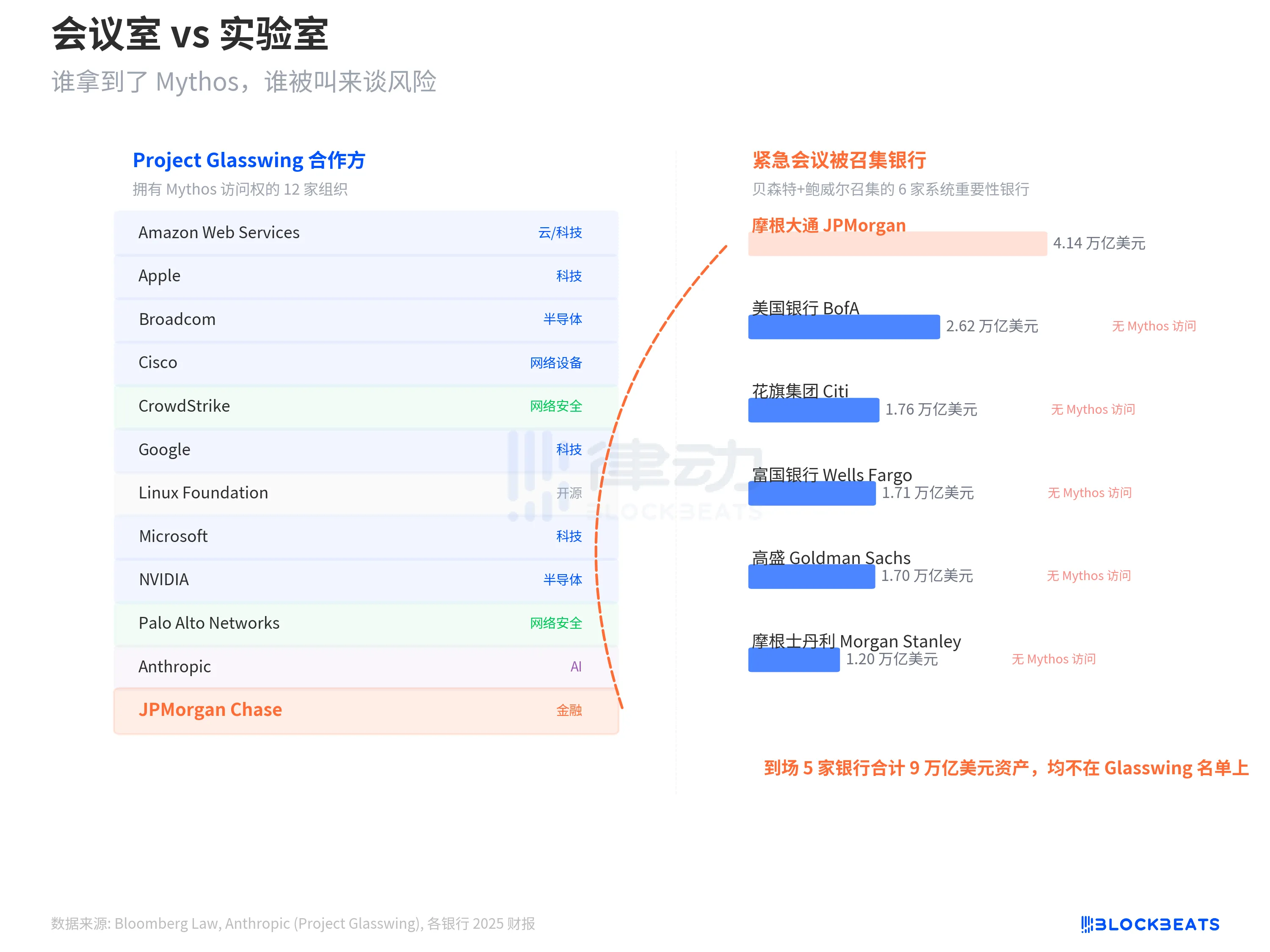
According to the Anthropic website, JPMorgan Chase is the only financial institution among Glasswing's 12 founding partners. The bank spends around $600 million annually on cybersecurity and reportedly has about 3,000 cybersecurity personnel. On the same day as the emergency meeting convened by Benson and Powell on April 8, analysts at JPMorgan Chase released a report recommending investment in CrowdStrike and Palo Alto Networks, citing the establishment of Glasswing as the reason.
On one side were the five banks called to discuss the threat, with no tools in hand. On the other side was the one bank that had the tool, with the CEO absent from the meeting, and the analyst still issuing buy ratings to partners. What Glasswing manufactured was not just a technological barrier but an information barrier.
What Happened in 44 Days
If you were to line up the federal regulatory actions Anthropic faced over the past six weeks, you would see an unprecedented chain reaction in both speed and direction.
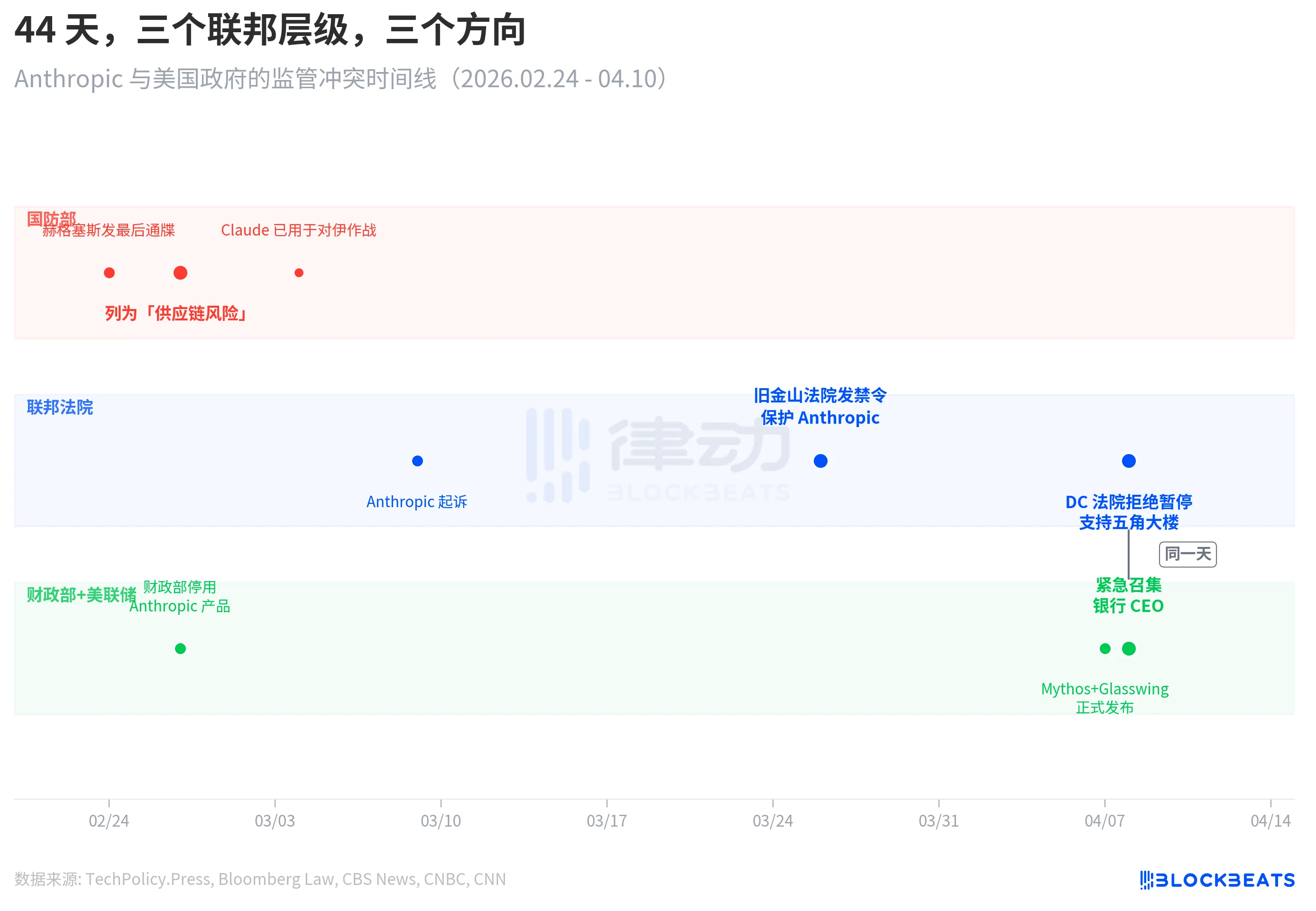
On February 24, Secretary of Defense Hegesius issued a final ultimatum to Anthropic CEO Amodei: accept the "any lawful use" clause by 5:01 p.m. on February 27 or face consequences. At the core of this clause was the dispute over two usage restrictions that Anthropic had retained in its contract with the Pentagon, prohibiting the use of Claude for large-scale surveillance and fully autonomous weapons systems. According to CBS News, Hegesius stated, "America's warriors should never be held hostage to Big Tech ideology." Pentagon's Chief Technology Officer Emil Michael added, "At some level, you have to trust that your military will do the right thing."
Anthropic refused. On February 27, Trump ordered federal agencies to cease using Anthropic products. That same day, Hegesius classified Anthropic as a "supply chain risk."
Over the next 44 days, three federal levels almost simultaneously took conflicting actions against Anthropic.
On March 26, San Francisco Federal Judge Lin issued a 43-page preliminary injunction, finding the Pentagon's actions "troubling" and potentially retaliatory against Anthropic, temporarily halting the enforcement of the supply chain risk designation. According to CNN, the judge wrote in the ruling that the government's actions "likely violated the law."
On April 8, the DC Federal Appeals Court denied the suspension of the Pentagon's designation, effectively overturning the protection granted by the San Francisco court. That same day, Bessent and Powell held that emergency meeting.
One court protecting the company, another court supporting sanctions against it, while the Treasury and the Fed discussed it as a systemic risk from a financial stability perspective. The same entity, within the same federal system, simultaneously seen as an innovator in need of protection and a threat to guard against.
Who Was the "Supply Chain Risk" Label Originally For?
The "supply chain risk" label is not just any administrative designation. It was originally a tool designed by the Federal Communications Commission (FCC) to address threats to the security of foreign communications equipment.
In 2019, Congress and the FCC initiated this designation process for Huawei and ZTE for the first time, citing their ties to the Chinese government, espionage obligations under Chinese law, and known security vulnerabilities in their equipment. In June 2020, the FCC issued a formal designation order. In 2021, Hikvision, Dahua, and Hytera were added to the list. In 2022, Russia's Kaspersky was also included.
According to FCC public records, prior to Anthropic, all entities listed under this designation were foreign companies, and all were foreign companies identified as having technical security risks.
On February 27, 2026, Anthropic became the first domestic U.S. company to be labeled a "supply chain risk." According to a report by TechPolicy.Press, the reason for the designation was not a technical security vulnerability but a breakdown in contract negotiation terms, as Anthropic refused to lift restrictions on AI use. According to an assessment by Northeastern University security policy researcher, this precedent could have a chilling effect on the entire AI industry, as refusing to cooperate with military use conditions could lead to the highest level of supply chain sanctions.
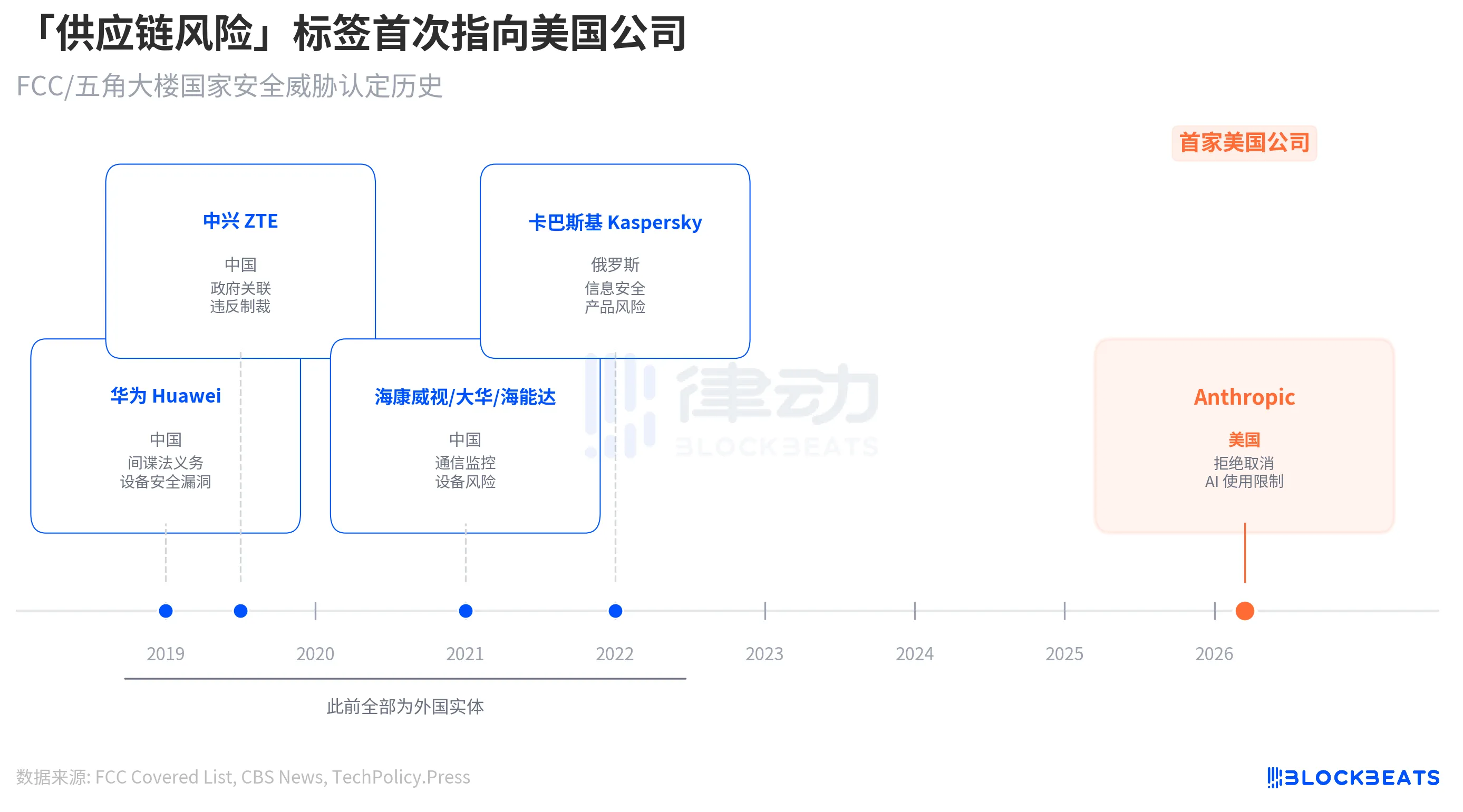
A sanctioning tool designed for Huawei was used for the first time to sanction a U.S. company that refused to allow its AI to be used for unrestricted military purposes. It's the same tool, but the logic of use has completely changed. On May 19, the DC Circuit Court of Appeals will hear oral arguments on this case.
When an AI model is both the best defense tool and the greatest systemic threat, existing regulatory frameworks have not been designed with any mechanism to address this duality of "capability as risk," and the process of filling this regulatory gap is happening in real time at a pace of a weekly federal-level event.
You may also like

Sharplink CEO: The future of Ethereum is unfolding

A Detailed Analysis of "Stock God Serenity" Investment Methodology

From Casino Tools to Global Pricing Machines: The NYSE Leader's Perspective on Hyperliquid

Morning Report | Korea Investment & Securities and OKX plan to jointly acquire 40% of Coinone; Polymarket denies implementing KYC comprehensively; Grayscale delays U.S. stock IPO plans

Bit Digital CEO: Why I Bought More ETH

A Decade of Three Waves of Stock Tokenization from Bitget's Reality: An Unfinished Financial Exploration

"Hu Run Baifu" Dialogue with Sun Yuchen: A New Paradigm of Value Circulation in the Web3 Transformation Cycle

Is it hackers and regulation that ruined DeFi?

Chris Lee: From crypto OG to heavy investments in the three storage giants, predictions on AI bull market corrections, Web4, and opportunities for the younger generation

Ready for a Walk on the Wilder Side of Proof of Talk 2026? Join WEEX Labs in Paris

Gold vs Bitcoin in 2026: Which Market Is Giving Traders Better Opportunities?

Morning News | Coinbase partners with Standard Chartered Bank to expand multi-currency fiat channels; Sharplink and Forward will be included in the Russell Index; JPMorgan may issue stablecoins in the future

Hash Global Founder: Why I Also Chose to Liquidate All My ETH?

Tokenized US Stock Duel: Ondo vs. xStocks, Who is Defining On-Chain Nasdaq?

He Yideng ranked: Since you're here, you might as well
The era of regulatory arbitrage has come to an end, and the value of cryptocurrency exchange licenses is being fiercely contested
Six Major Complaints from an Ethereum Developer

The truth about global payments has been revealed by Airwallex
Sharplink CEO: The future of Ethereum is unfolding
A Detailed Analysis of "Stock God Serenity" Investment Methodology
From Casino Tools to Global Pricing Machines: The NYSE Leader's Perspective on Hyperliquid
Morning Report | Korea Investment & Securities and OKX plan to jointly acquire 40% of Coinone; Polymarket denies implementing KYC comprehensively; Grayscale delays U.S. stock IPO plans
Bit Digital CEO: Why I Bought More ETH
A Decade of Three Waves of Stock Tokenization from Bitget's Reality: An Unfinished Financial Exploration

Contents
Popular coins
Latest Crypto News


