
How to Set Leverage on WEEX: A 2026 Step-by-Step Guide

 Prefer us on Google

Leverage lets you control a bigger position than the money you actually put in. On WEEX, leverage goes up to 10x for all clients – retail and professional alike. With 100margin,you can open a 100 margin,you can open a 1,000 position. That's 10x leverage. The setting works the same no matter how you got classified.
Leverage is one of the most important settings to understand before you trade. It decides your market exposure, how fast gains and losses add up, and how close your liquidation price sits to your entry. Getting leverage right isn't about maxing it out. It's about matching it to the move you expect and the loss you can take if you're wrong.
How Leverage Works
Leverage lets you control a bigger position than the money you put in.
Example: You have 100.With10xleverage,youcontrola100.With10xleverage,youcontrola1,000 position. If the price moves 1% in your favor, you gain 10(1010(10100). If it moves 1% against you, you lose $10.
That sounds great until it goes against you. A 10% move against a 10x position wipes out your entire $100.
Leverage also determines your liquidation price. Higher leverage = liquidation price closer to current price. Always check that number before clicking buy or sell.
How to Set Leverage on WEEX
Setting leverage on WEEX is straightforward. You do it in the order panel before placing a trade.
Step-by-step Guide:
1. Open the WEEX trading interface and navigate to the perps or margin section.
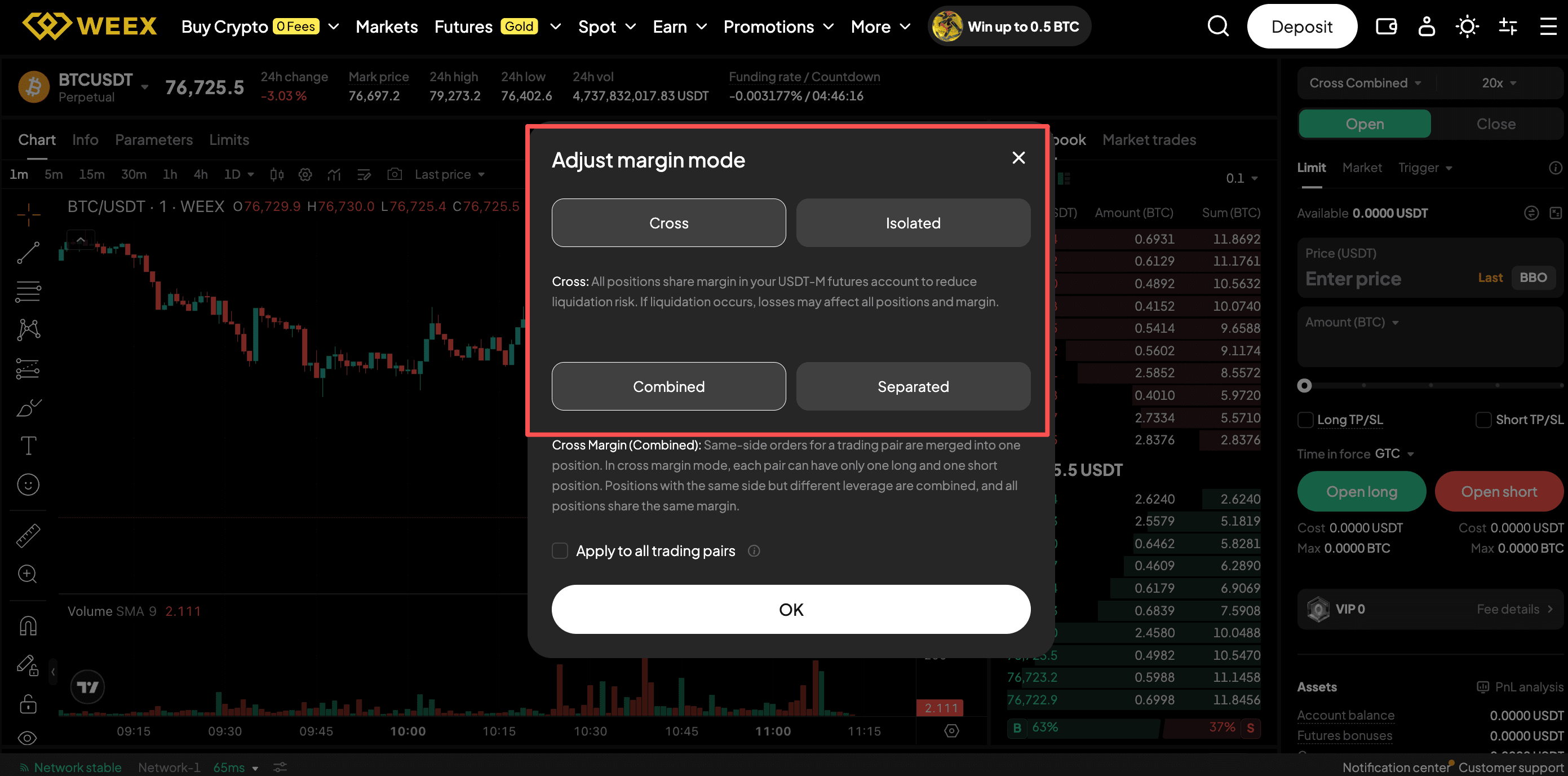
2. Choose your margin mode – Isolated or Cross.
3. Find the leverage selector. It shows as a multiplier (e.g., 10x).
4. Click the leverage value. A slider or input field pops up.
5. Adjust to your chosen level. WEEX offers up to 400x leverage on some trading pairs.
6. Watch the estimated liquidation price update automatically. If it's uncomfortably close to current price, lower your leverage.
7. Place your order.
Key point: Leverage is set per order, not per account. You can use 2x on one position and 10x on another.
Isolated Margin vs Cross Margin: What's the Difference?
Your leverage setting and margin mode work together. You need to understand both.
Isolated Margin
- Risk is limited to the margin you put into that specific position.
- If the trade gets liquidated, you only lose that position's margin. The rest of your account stays safe.
- Best for: most traders, especially beginners. You know exactly how much you can lose.
Cross Margin (called "Selected" on some platforms)
- Your entire account balance backs all open positions.
- A losing position can use margin from winning positions to stay alive longer.
- But if the total account drops below maintenance margin, everything gets liquidated at once.
- Best for: hedging or advanced traders who know what they're doing.
WEEX advice for beginners: Use Isolated Margin with lower leverage. Know your max loss before you enter the trade.
How to Choose the Right Leverage
There's no "correct" leverage for everyone. It depends on your strategy, risk tolerance, and how much room you want before liquidation.
Ask yourself this: "How much am I willing to lose on this trade?" Not "how much leverage can I get?"
Set your max acceptable loss first. Then adjust leverage so your stop-loss triggers before liquidation. That way you exit on your terms, not the platform's.
Low Leverage (1x–3x)
Gives your position room to breathe. A 2x position needs a 50% move against you to get liquidated.
When to use low leverage:
- Holding positions for hours or days
- Expecting volatility and don't want to get shaken out
- Less certain about timing
- New to derivatives
High Leverage (7x–400x)
Compresses the distance between entry and liquidation. At 100x, a 1% move against you wipes out your margin.
When higher leverage might make sense:
- Well-defined entry with a tight stop-loss
- Actively monitoring the position
- Short-term, high-conviction trade
- Experienced trader
When to avoid high leverage:
- Holding overnight
- Uncertain about timing
- New to trading
- Can't watch the position
WEEX offers up to 400x leverage. That does not mean you should use it. Most professionals trade under 10x.
A Useful Rule of Thumb
Before placing any leveraged order, check the estimated liquidation price in the order panel. If it's closer to current price than you're comfortable with, lower your leverage or add more margin.
Don't guess. The number is right there.
Conlusion
Setting leverage on WEEX is simple. The order panel shows you everything. Leverage slider, liquidation price, margin required.
The hard part is choosing the right leverage for your risk level. Start low. 2x or 3x. Use isolated margin. Set stop-losses. Check liquidation price before every trade.
High leverage is tempting. One good trade and you double your money. One bad trade and you lose everything. The math doesn't care about your feelings.
Ready to trade? WEEX offers zero fees, instant execution, and the security you need. Sign up on WEEX Now and Start Trading!
FAQ
How do I set leverage on WEEX?
On web: open the order panel, find the leverage selector, click it, adjust the slider. On app: tap the leverage value in the order panel, use the slider to adjust. Leverage is set per order.
What is the maximum leverage on WEEX?
WEEX offers up to 400x leverage on some pairs. Most traders should never use that. Start with 2x-10x.
What's the difference between isolated and cross margin on WEEX?
Isolated margin limits risk to one position. Cross margin shares your whole account balance across all positions. For beginners, isolated is safer.
What leverage should a beginner use on WEEX?
Start with 2x or 3x leverage. Use isolated margin. Trade small position sizes. Learn how liquidation works with tiny amounts first.
Is high leverage dangerous?
Yes. High leverage compresses your liquidation price. A 1% move against a 100x position wipes out your margin. Only experienced traders should use high leverage, and only with tight stop-losses.
Disclaimer: This content is provided for general branding and informational purposes only and doesn't constitute financial, investment, legal, or tax advice. Any events, rewards, online events, or related information mentioned herein should not be considered a recommendation, solicitation, or invitation to purchase, sell, trade, or otherwise deal in any crypto assets or to use any services. Crypto assets are highly volatile and may result in loss. WEEX services and online events may not be available in all regions and are subject to applicable laws, regulations, and eligibility requirements. You are responsible for ensuring that your use of WEEX services complies with local laws and for carefully assessing the risks before participating in any crypto-related activities.
You may also like

How to Use Grok AI for Crypto Trading: A Practical Guide for 2026
Polymarket vs. Kalshi: Which Prediction Market Platform Survives the Regulatory Crackdown?

How to Read Prediction Market Odds: A Complete Beginner's Guide

What Is Liquidity in Prediction Markets and Why Does It Matter?
How Accurate Are Prediction Markets? What the Research Actually Says
Is Polymarket Legal in the US? What the CFTC Approval Actually Means

Tokenization in Crypto vs Data Security: What Is Tokenization and How Both Protect Your Assets?

Can Crypto Copy Trading Really Make You Money? Is Copy Trading Legit or Scam? Full Guide to WEEX Copy Trading

Play-to-Earn Crypto Games: Complete Guide to P2E Gaming in 2026

How to Buy U.S. Stocks on WEEX: A Complete 2026 Guide to Trading with USDT
What Is TradFi? How Traditional Finance and Crypto Are Converging in 2026
WXT Token Total Supply: How WEEX Token Supply and Burns Work
WXT to USDT: A Beginner's Guide to Converting WEEX Token into USDT

What Is MetaMask? A Complete Guide to the World's Most Popular Web3 Wallet
How to Trade Presidential Election Betting Odds in 2026: The Complete Guide
What Is the US Election Prediction Market? How to Trade on Trump Odds in 2026
Top 4 Altcoins to Buy in July 2026: Top Crypto Picks for Investors
Who Is Jensen Huang? Nvidia CEO's Net Worth, Biography & NVDA Stock Analysis 2026. Is NVDA Stock a Good Buy Right Now?
Prediction Market Regulation: Polymarket, Kalshi and Future Trends

Polymarket vs Kalshi: The Future of Prediction Markets Explained
Polymarket vs Kalshi: The Future of Prediction Markets Explained

Prediction Market Arbitrage Explained: How Traders Find Profits

How Polymarket Market Making Works: Risks and Profit Strategies
What Is a Prediction Market? Complete 2026 Guide to Polymarket, Kalshi & Crypto Betting Platforms
Nvidia vs Microsoft Stock 2026: Which AI Giant Is the Better Buy in July?
MicroStrategy's STRC Unpegged: Buy the Dip or Brace for Impact?
How to Buy Cryptocurrency on WEEX Exchange 2026: Full Guide
Prediction Market Apps 2026: How Prediction Markets Work? Are They Safe and Legal?
Is Polymarket Legal in India in 2026? Key Legal Updates on Prediction Markets
14 Best Prediction Market Apps in 2026: The Ultimate Guide to Crypto-Native and Regulated Platforms
How to Use Grok AI for Crypto Trading: A Practical Guide for 2026
Polymarket vs. Kalshi: Which Prediction Market Platform Survives the Regulatory Crackdown?
How to Read Prediction Market Odds: A Complete Beginner's Guide
What Is Liquidity in Prediction Markets and Why Does It Matter?
How Accurate Are Prediction Markets? What the Research Actually Says
Is Polymarket Legal in the US? What the CFTC Approval Actually Means
Contents
Popular coins
Latest articles


